The quality of demand forecasting is a decisive lever for working capital and service level in modern supply chains. In reality, however, many companies still struggle with manual planning workflows and fragmented data structures that tie up valuable time and resources. This blog post takes a closer look at the most common hurdles in supply chain planning: from the time-consuming consolidation of manual Excel spreadsheets to the operational risk of relying on expert knowledge that resides with individuals rather than within the organization.
You will also learn how a “Slim Build AI” approach provides a methodical way forward: by implementing modular, quickly deployable AI components, value becomes visible immediately and efficiency increases sustainably. We show how to shift from admin‑heavy processes to strategic, data‑driven steering within weeks.
Demand forecasting quality has a major impact on a company’s working capital and delivery reliability. Yet in many organizations, valuable capacity is still consumed by administrative tasks, such as consolidating heterogeneous data sources and manually maintaining complex spreadsheet structures. That time is then often missing where it matters most: strategic planning and the assessment of seasonality or shifting market trends. To improve planning quality sustainably, companies need solutions that integrate seamlessly into existing processes and fit intuitively into day-to-day work.
Below, we examine the key challenges in modern planning and show how modular AI can create a fast transition to objective, data‑driven forecasting.
The status quo of demand planning: Between experience and operational complexity
In many mid-sized companies, sales and demand planning still relies on a mix of historical experience and manually maintained spreadsheets. In more stable market conditions, that approach was often sufficient. But rising volatility, disruptions across global supply chains, and an expanding product and variant landscape have pushed complexity to a level that’s becoming nearly impossible to manage through manual efforts alone.
Most of the necessary data already exists in the ERP system, but it’s often siloed and difficult to use in practice. Attempts to unlock this data with large enterprise software suites frequently fall short because implementation timelines are simply too long, and by the time the system goes live, business needs have already moved on. At the same time, these monolithic platforms tend to overwhelm users with features they don’t need, while still lacking the targeted capabilities that would actually make daily work easier.
Current challenges summarized into 4 key pain points: Where planning loses resources
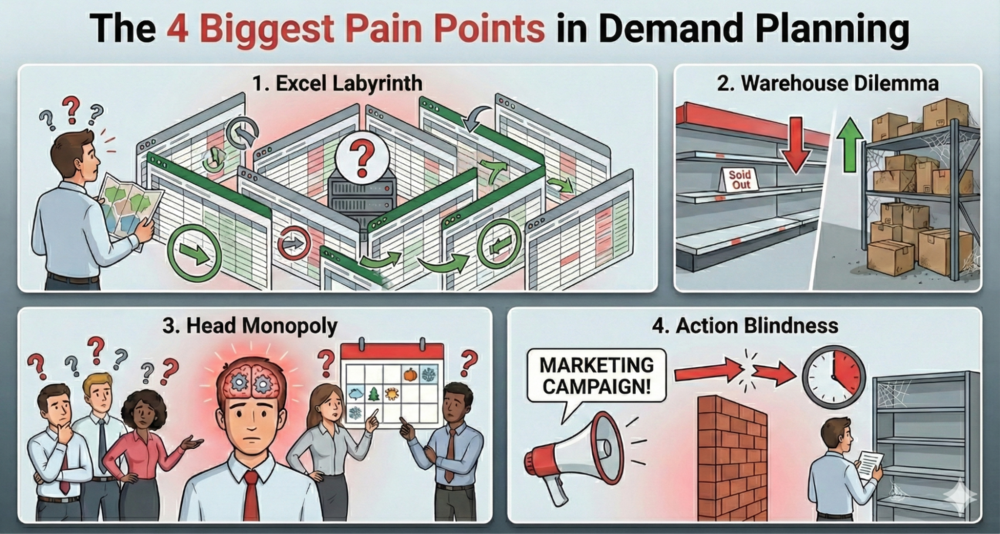
1. The Excel labyrinth: When consolidation replaces analysis
A classic scenario in day-to-day planning: multiple planners work with their own Excel files, which then need to be consolidated into a single “master” document on a regular basis. Along the way, critical friction points often emerge:
Version chaos: Shared folders quickly fill up with files named things like Planning_V2_final_corrected.xlsx. Who updated what, when – and based on which version? Tracking down the single source of truth costs time, patience, and trust in the numbers.
Administrative overhead: Who chases everyone for the latest updates? Who checks the manually merged tables for errors and inconsistencies? Instead of improving forecasts, teams end up spending precious capacity on data collection and maintenance.
Numbers vs. context: Each planner doesn’t just enter figures – they also add comments and qualitative notes in free text. But how are these insights captured and reflected in the final plan? Too often they’re ignored entirely, meaning critical context gets lost – and forecasts can become less accurate as a result.
2. The warehouse dilemma: Working capital vs. service level
Many companies find themselves stuck with both “too much” and “too little” inventory at the same time. Without precise, data-driven forecasting, every purchasing decision becomes a bet on the future. The outcome is often an unhealthy imbalance: slow movers clog the warehouse and tie up valuable working capital, while bestsellers end up out of stock at exactly the moment demand peaks. In this environment, a forecasting error translates directly into lost revenue, frustrated customers or, on the other side, unnecessary holding costs.
A typical Monday morning in many companies: it’s 8:15 a.m., the coffee is still hot, but the mood in logistics is already boiling over. A top seller is out of stock, while in Warehouse Hall 3, slow movers are tying up valuable capital. The team then spends the rest of the morning not on strategic planning, but on firefighting: expediting orders, placing rush replenishments, and calming frustrated customers.
If your supply chain is still running on line-of-sight planning, you’re not just burning nerves – you’re burning cash. But what if the issue isn’t a lack of effort, but a toolkit that simply isn’t built for today’s level of complexity anymore?
For a practical overview on optimizing safety stock – and balancing service level with working capital – see: Optimize inventory management.
3. The head monopoly: When your supply chain depends on individuals
Does your company’s ability to deliver depend on the implicit knowledge of a few key people? In many organizations, the “gut feeling” of long-tenured experts is the only real corrective in the planning process. But that creates a significant strategic risk whenever roles change because there’s no system that turns this know-how into an objective foundation for decision-making that the whole team can rely on.
Most teams have heard it before: “That’s how we’ve always done it.” Or: “Herbert just knows how the market breathes.” Too often, delivery performance hinges on the unspoken expertise of a handful of experienced colleagues. And that’s risky because what happens when “Herbert” is on vacation, falls ill, or retires? Suddenly, the planning intelligence leaves the company with him.
Without a data-driven backbone, this house of cards can collapse quickly when personnel changes occur. If there’s no system that captures, structures, and shares company- and customer-specific knowledge – making it accessible beyond individuals – your supply chain remains unnecessarily vulnerable and opaque.
4. Action blindness: When silos put delivery performance at risk
In many companies, Marketing, Sales, and Supply Chain operate like separate islands. A familiar scenario: Marketing plans a major discount push or a social media campaign to boost demand, yet Supply Chain only finds out once inventory is already critically low or the product is simply sold out.
This lack of synchronization creates serious issues:
- The information lag: Manual planning processes are often so slow that short-term market shifts or planned promotions only show up in demand plans weeks later. By the time the Excel sheet has been updated, the campaign is often already over.
- Method overload: Traditional history-based models (or simple spreadsheets) struggle to handle external “special effects.” What does a sudden cold snap do to charcoal sales? How much demand does a viral trend create for a niche product? In manual systems, these drivers remain blind spots.
- The cost of blindness: The outcome is painful either way. You lose revenue because you can’t meet the demand peak (lost sales), or you react in panic mode with expensive express shipments and special production runs – wiping out the margin from the carefully planned marketing initiative.
A modern forecasting approach eliminates this “action blindness” by automatically integrating external signals: from internal promotions and campaign calendars to weather forecasts and market trends. Planning shifts from looking in the rearview mirror to becoming a forward-looking control system, breaking down silos and making marketing success operationally achievable in the first place.
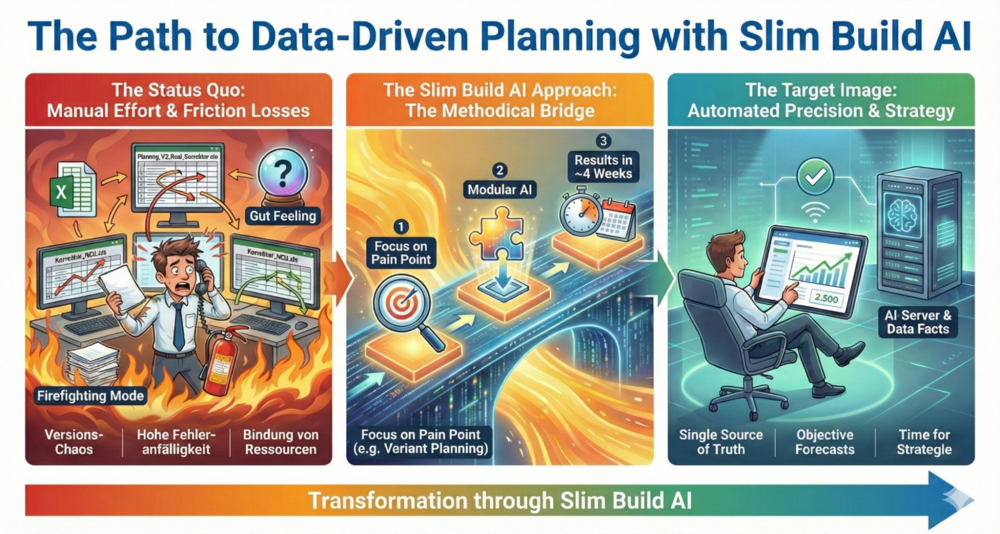
A methodical way out: The Slim Build AI approach
To overcome these hurdles without sinking time and budget into sprawling IT mega-projects, a modular approach has proven highly effective – what we call Slim Build AI. The goal isn’t to revolutionize your entire IT landscape in one big bang. Instead, we focus precisely where the biggest pain point sits and create impact fast.
The methodological pillars of this approach:
Modularity over monoliths: Instead of rolling out a rigid, all-in-one software suite, we develop purpose-built AI modules that connect to your existing data sources and tools.
Short iteration cycles: A working module (for example, AI-powered variant planning) delivers tangible results within weeks instead of months or years. That makes it easy to validate ROI early and scale what works.
User-first adoption: Intuitive usability ensures the solution fits naturally into daily workflows – so it’s not just implemented, but actually used. And when AI takes over routine forecasting, planners get their time back to focus on strategic exceptions and high-impact decisions.
Conclusion: Data‑driven decisions as a strategic advantage in demand planning
Accurate demand forecasting isn’t an end in itself: it’s the foundation of a resilient supply chain. By moving from manual spreadsheet maintenance to automated, modular AI forecasting, companies can not only reduce costs, but also create lasting relief for their teams. In this context, focus beats complexity: those who invest deliberately avoid “Excel burnout” and build a scalable base for the future.
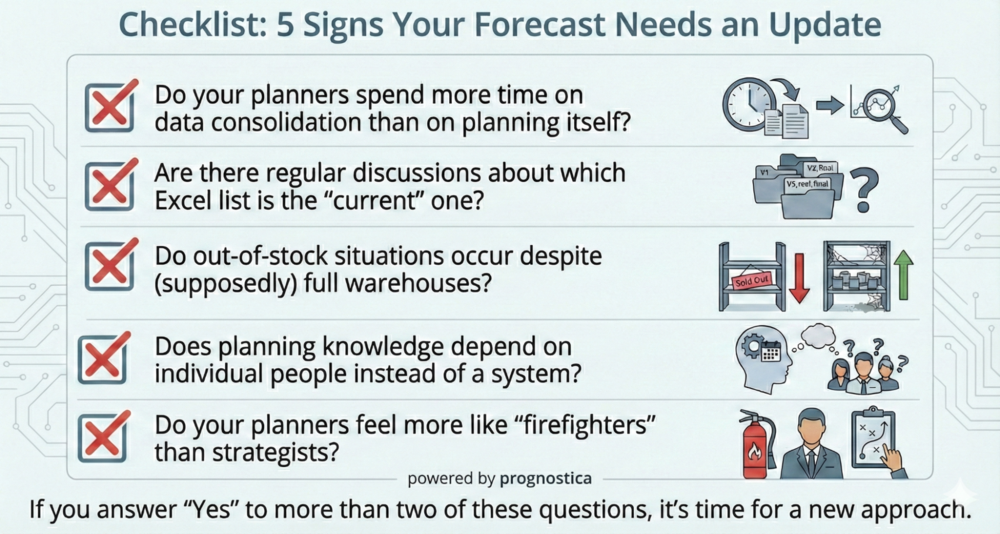
Learn more about Slim Build AI
Would you like to delve deeper into the methodological details or see how such a solution works in practice? Visit our information page or take a look at our demo app!