Too many deviations
Teams see long lists, but no clear prioritization by business impact, risk, or decision urgency.
Agent workflows for forecasting
The real work starts after the forecast. Changes need to be detected, forecasts updated where necessary, and critical cases prepared properly for demand review and S&OP. That is exactly where our AI agents help.
In many planning organizations, the bottleneck is not the forecast calculation itself, but the question of how deviations, risks, and assumptions are turned into reliable decisions for demand review and S&OP.
Agents
From forecast to decision
↓
less manual preparation for demand reviews and S&OP meetings
↑
more focus on business impact, priorities, and reliable decisions
In many planning meetings, valuable time is spent identifying deviations, going through spreadsheets, reconstructing root causes, and clarifying responsibilities. At the same time, new questions often arise during the meeting because an unusual event or a previously unconsidered development suddenly becomes relevant. The truly critical cases are not always discussed first.
Teams see long lists, but no clear prioritization by business impact, risk, or decision urgency.
Events, data errors, overrides, promotions, or supply issues must be reconstructed manually. Data silos between sales, supply chain, procurement, and controlling make the problem worse.
Decisions, assumptions, and to-dos disappear between two review cycles. As a result, planning remains reactive instead of becoming learning-driven and proactive.
An unexpected event, a new market shift, or an unusual development suddenly raises questions that nobody prepared beforehand. That is exactly when teams often lack the time to provide the right data, context, and scenarios quickly.
Agent capabilities
A forecasting agent is not a rigid off-the-shelf product. It can do exactly what makes sense for your specific use case: together, we define requirements, priorities, and desired workflows and translate them into fitting, reliable, and practical agent capabilities. These could include, for example:
The agent continuously detects relevant changes in data, assumptions, portfolio, events, or boundary conditions and knows when action is needed.
It identifies relevant deviations and ranks them by economic relevance, risk, and decision urgency.
It makes clear why a deviation occurs, which logic is behind it, and which influencing factors matter most.
When something material changes, the agent can trigger reforecasting, make differences transparent, and provide the updated view.
It brings together the relevant information for reviews and meetings instead of forcing teams to collect it manually from different sources.
KPIs, views, ad hoc analyses, and questions can be tailored dynamically to the specific decision need.
It supports what-if analyses and helps reconcile operational developments with strategic targets.
The agent creates the right visualizations exactly when they are needed for analysis, discussion, or decision-making.
It documents what was decided, which assumptions apply, and what needs to be followed up until the next review.
Practical examples
Not as abstract technology, but as concrete support for preparation, analysis, and decision-making.
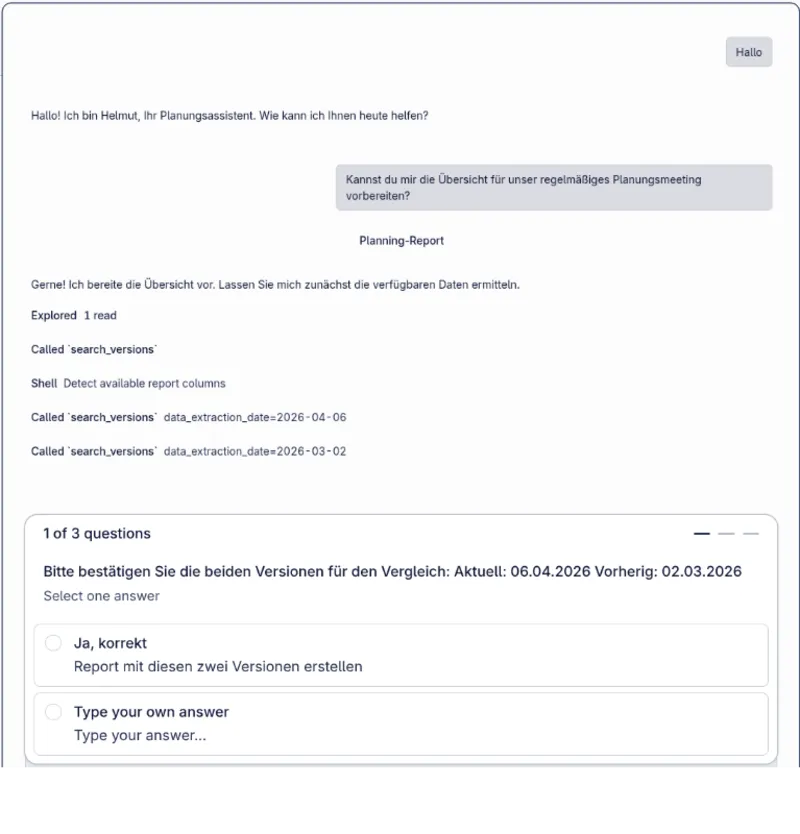
Practical example 1
The agent automatically consolidates relevant data, deviations, and signals from different sources and prepares the decisive cases for the planning meeting in a structured way.
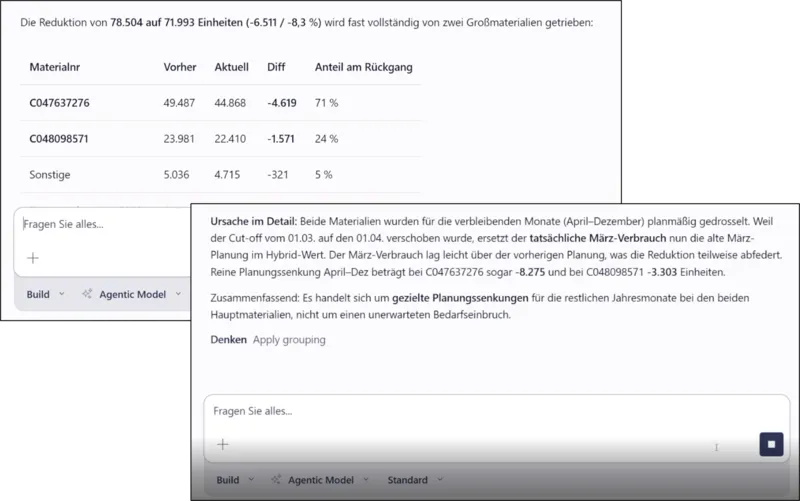
Practical example 2
Instead of merely looking at red numbers, the agent shows which drivers, changes, or assumptions are behind a deviation and why it matters for planning.
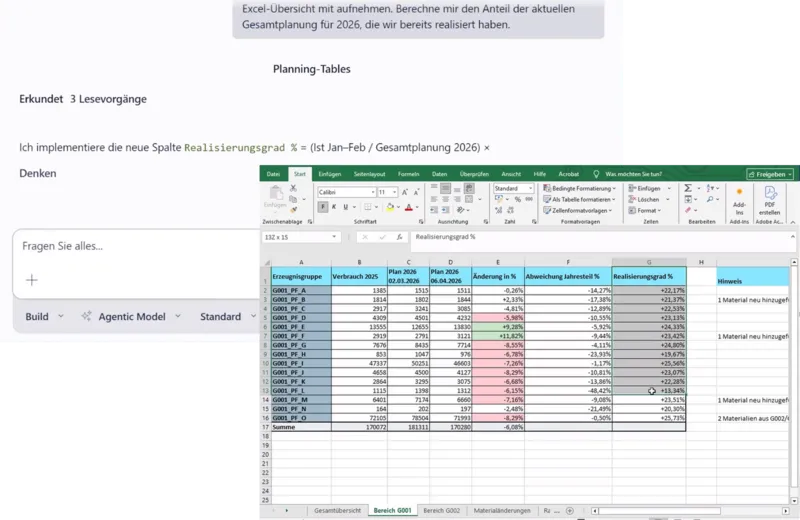
Practical example 3
KPIs and analyses can be adapted dynamically to the current discussion instead of being limited to rigid standard reports.
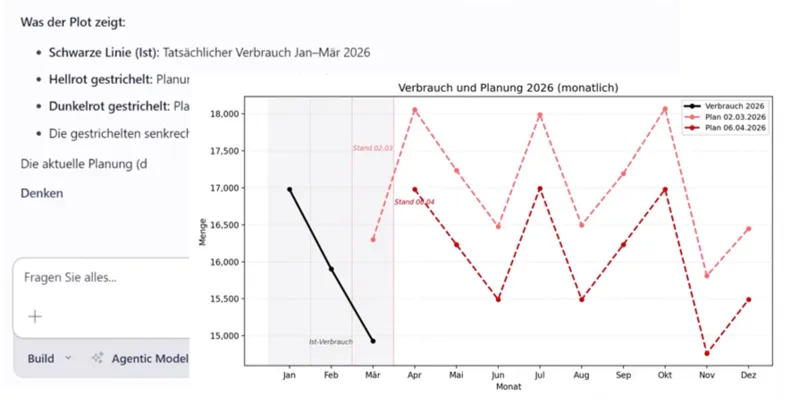
Practical example 4
When a new question arises in the meeting, the agent can generate fitting visualizations on the spot and make relationships easier to understand.
Agent workflow
1. Data & forecasts
Forecasts, history, events, plan values, overrides, inventories, supply data
2. Analysis
Quality checks, deviations, patterns, risks, early warning signals
3. Prioritization
Critical cases for review, escalation, and management decisions
4. Preparation
Agenda, explanations, KPI comments, charts, scenarios, and action recommendations
5. Learning
Documentation, action tracking, impact checks, and performance tracking
Why prognostica?
A good S&OP agent needs more than LLM technology. It needs to understand forecasting KPIs, planning logic, data quality, hierarchies, events, service-level targets, and planner workflows.
That is exactly where our focus lies: we combine forecasting, scenario analysis, early warning systems, and generative decision support into a usable workflow directly for demand review and S&OP.
The goal is not more information, but better preparation for decisions: more efficient data work, better-founded discussions, and traceable actions.
Typical agents
Functional strength
Together, we assess which agent use case offers the greatest leverage for your S&OP or demand-review team and how to implement it in a way that aligns with your requirements and system landscape.