MCP meets futureEXPERT: Together with students from Kiel UAS, we created three AI‑agent tools that automate core forecasting steps. The result: transparent forecasting pipelines instead of manual click trails.
AI is moving fast. Just as we got used to chatbots, the Model Context Protocol (MCP) arrives: standardized interfaces that let AI systems interact safely and easily with data and tools.
But what does this look like in practice? To explore this, we worked with students from the Kiel University of Applied Sciences. They investigated what happens when you combine young talent, modern agent technology, and our Forecasting‑as‑a‑Service tool futureEXPERT.
The result is “Birte 2.0” – a technical showcase that demonstrates how intuitive forecasting with real data becomes when using coding agents.
What is the Model Context Protocol (MCP)?
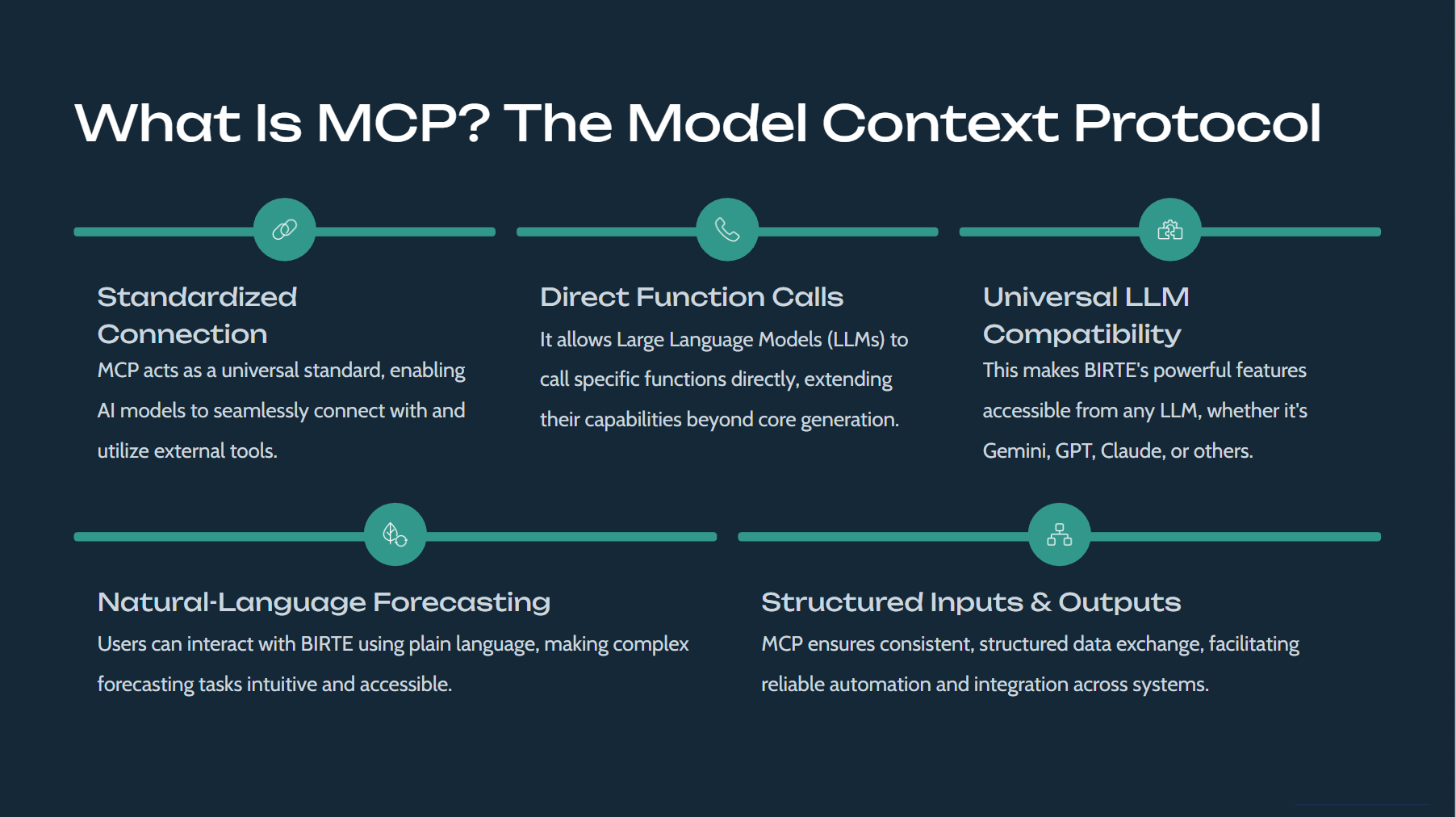
In short: MCP is the new standard for connecting LLMs to external tools and data (LLMs = Large Language Models). Instead of building custom integrations for every use case, MCP offers a universal plug.
As part of the project, a local MCP server was set up to provide specific tools. A coding agent (e.g., Claude Code) can then use these tools autonomously.
The agent itself never loads sensitive time‑series data into its context. It operates with filenames and metadata to orchestrate processes. Data processing happens locally or – for forecast generation – directly via the futureEXPERT API, without the agent needing to ingest raw data.
The agent as conductor: from intent to solution
Before we dive into the tools, let’s have a quick look at the intelligence that drives them. What sets an agent apart from a classic chatbot? While a chatbot mainly generates text, an AI agent is an operational problem solver: it plans, uses digital tools, and reaches complex goals step by step. In the students’ implementation, the coding agent takes precisely this role and orchestrates the MCP tools autonomously:
Understanding, not just executing: The agent reads the technical descriptions of the available tools and interprets user intent. When the user says “create a forecast for the sales data”, the agent understands which steps are needed.
Repository search: The agent searches the local repository for matching CSV files. The user doesn’t need to know the exact path.
Logical order: It calls the tools in a sensible chain (clean data, detect events, then forecast) and reacts dynamically to tool feedback.
Follow-ups when ambiguous: If the agent encounters ambiguities – for example, two similarly named files or missing parameters – it asks targeted clarification questions.
The three pillars of Birte 2.0
The students’ task was to extend our virtual AI assistant Birte with new capabilities. As an intuitive chat interface to our forecasting backend, Birte already supports drag‑and‑drop data upload and returns forecasts on simple prompts (e.g., “create 14‑day forecasts”) – no technical jargon required.
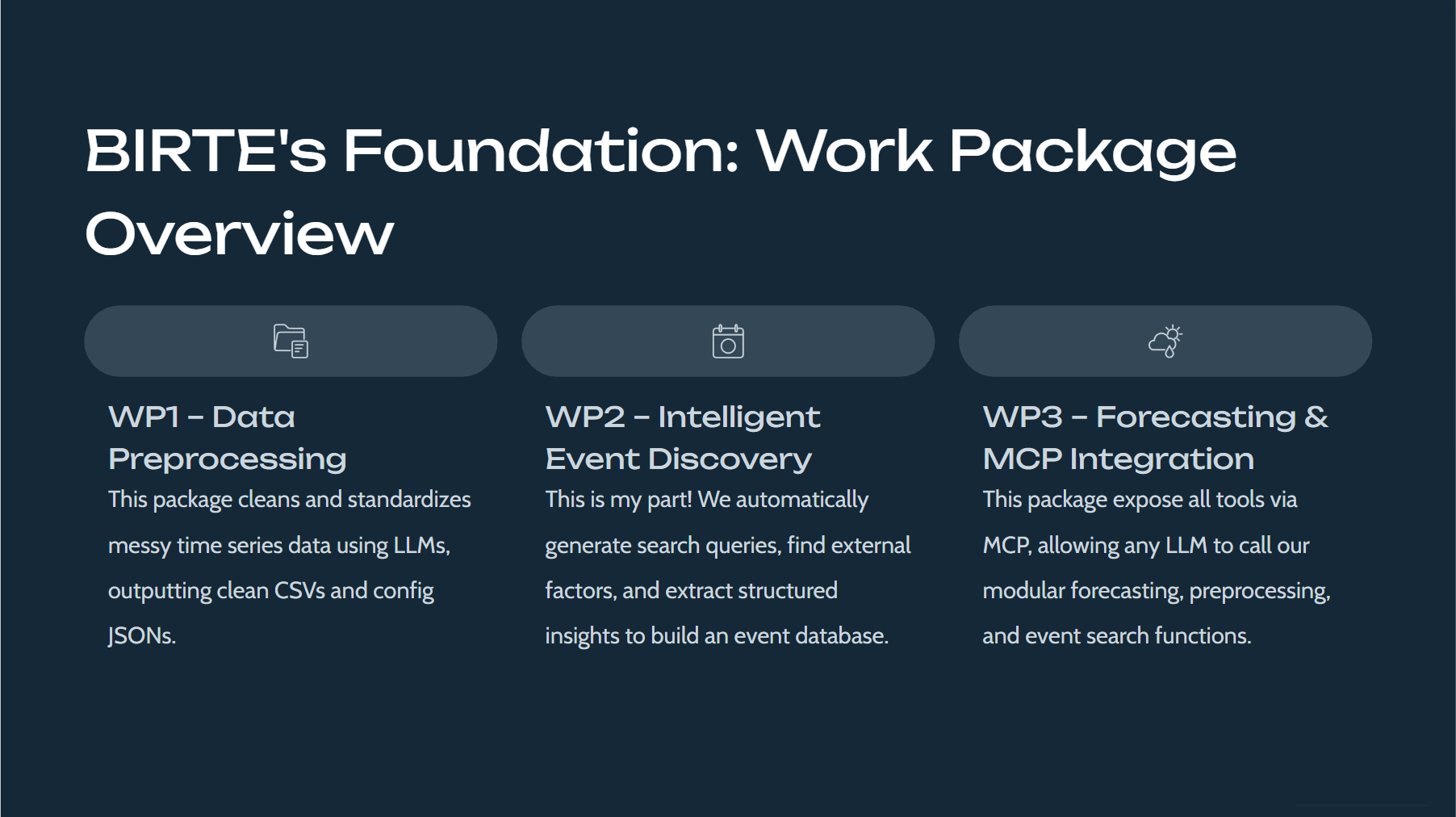
On that basis, three MCP tools were built to solve specific forecasting problems:
1. Smart data preprocessing
The problem: data in the real world rarely arrives in the format a forecasting algorithm expects. Formats are inconsistent, delimiters are wrong, or columns are unnamed.
The solution: the preprocessing tool ingests raw CSV files and prepares them automatically. It detects formats, cleans up columns, and stores essential metadata for downstream forecasting. If there are uncertainties in the structure, the tool can trigger clarifying questions – which the coding agent or the user can resolve. The result is a clean data foundation based on a simple instruction like “prepare my CSV file.”
2. Event search and contextualization
The problem: plain numbers are blind to the outside world. A sudden price increase is often not explained by math alone but by external causes (e.g., policy decisions).
The solution: targeted event search. The agent uses this tool to scan news sources for events that may have influenced the data (e.g., “search for drivers of recycled‑material prices”). The tool returns not only news, but also a first estimate of the strength of the impact on the time series. A “dumb” time series becomes a context‑rich analysis.
3. Forecasting with futureEXPERT
The problem: professional forecasting often requires choosing complex parameters. What horizon makes sense? Which method fits the data?
The solution: the students wrapped the power of futureEXPERT into an MCP tool. The agent uses metadata captured during preprocessing to preconfigure the API call. For business‑relevant parameters such as the forecast horizon, the agent interacts with the user. This makes professional forecasting accessible – without writing code.
Why forecasting with agents?
Why let an agent handle these tasks? The barrier to entry drops massively.
Until now, professional forecasting often required deep technical understanding and studying lengthy documentation. With futureEXPERT, sensible methods are already chosen automatically – but the path often ran through code. With MCP and agents, that changes:
- No documentation needed: The agent already knows the tools. It knows which parameters futureEXPERT needs and how to pass the data.
- Natural language as the interface: Users describe goals in everyday language. The agent translates that into precise API calls.
- Efficiency and error correction: The agent can detect errors and adjust parameters without manual intervention.
Insights from academia
This project showed once again how valuable the exchange with academia is. It’s not just about knowledge transfer – it’s about getting fresh impulses and, in return, bringing industry impulses into universities.
We deliberately gave Kiel UAS students a lot of freedom in architecture. It’s inspiring to see how naturally the students used futureEXPERT as a foundation to build entirely new, agent‑based workflows on top. It shows our technology is a robust base that excites the next generation of data scientists – and encourages them to create their own solutions.
Conclusion: MCP makes scalable forecasting flexible and accessible
We would like to sincerely thank the student team for developing the MCP server. This fascinating Proof of Concept demonstrates that combining the forecasting power of futureEXPERT with the flexibility of MCP creates powerful tools that simplify complex data science tasks.
We are excited to build on these insights to make forecasting even more accessible by bridging the gap between research and practical application.
Tired of buzzwords? Let’s create AI solutions that actually deliver.